Kitsch style interior decoration
Kitsch interior design divides opinion; however, when it is planned judiciously, it is a powerful, fun and deeply personal language. In this article, we'll explain what it is, how to bring it home without going overboard and, above all, how to do it tastefully.
What is kitsch in interior design?
Before jumping into buying neon lamps or vintage porcelain, it's a good idea to establish definitions. When we talk about kitsch style, we are referring to an approach that mixes objects of high and low cultural value without complexes: from pop art to tourist souvenirs, retro furniture, new pieces with a nostalgic aesthetic and, of course, an intense colour palette. However, it is not chaos without rules: success comes when we select, we edit and we compose.
Why kitsch decorating style seduces today:
- Because it allows us to express identity without asking permission.
- Because it relativises the solemnity of "good taste" and replaces it with "proper taste".
- Because, well measured, it turns a home into a memorable experience.
In short, kitsch decoration is an emotional aesthetic; and, paradoxically enough, it requires method to make it work.
The principles of kitsch-style interior decoration
To keep kitsch from becoming visual noise, we apply four simple principles:
- Visual hierarchy
We arrange the room by planes: background (walls and large pieces), middle (main furniture) and front (objects, art, lamps). The intensity increases from back to front. This allows the eye to travel through the room without fatigue. - Conscious repetition
We intentionally repeat colours, materials or motifs. If we put bubblegum pink on a poster, we repeat it on a cushion, a lamp or a border; the whole is "anchored". - Calibrated contrast
The kitsch decorative style works with contrasts: gloss/matt, plain/stamped, pop/classic. But every contrast needs visual rest around it, like a breathing musical solo. - Humour and quality
Yes to humour and irony; no to poor quality that breaks down in weeks. We can mix a souvenir with a well-upholstered armchair: friction is what makes us smile.
Kitsch colour palette, materials and textures
Chromatic energy is the fuel of the kitsch style of interior decoration.
- Warm neutral base: bone, cream or taupe for walls and large upholstery.
- Main colours: fuchsia, turquoise, lemon, acid green, pop orange... in light doses.
- Metal and gloss: brass, chrome, high gloss lacquers, methacrylate and rounded mirrors.
Materials that fit:
- Woods with visible grain (from mid-century to natural oak).
- Textiles with weft (velvet, bouclé, chenille) to give "weight" to the ensemble.
- Quality plastics, methacrylates and polished metal parts provide sparkle.
Pro tip: when you are afraid of "going overboard", reduce one supporting colour and multiply the texture. Texture sophisticates kitsch.
Kitsch style in living room decoration
- Star wall
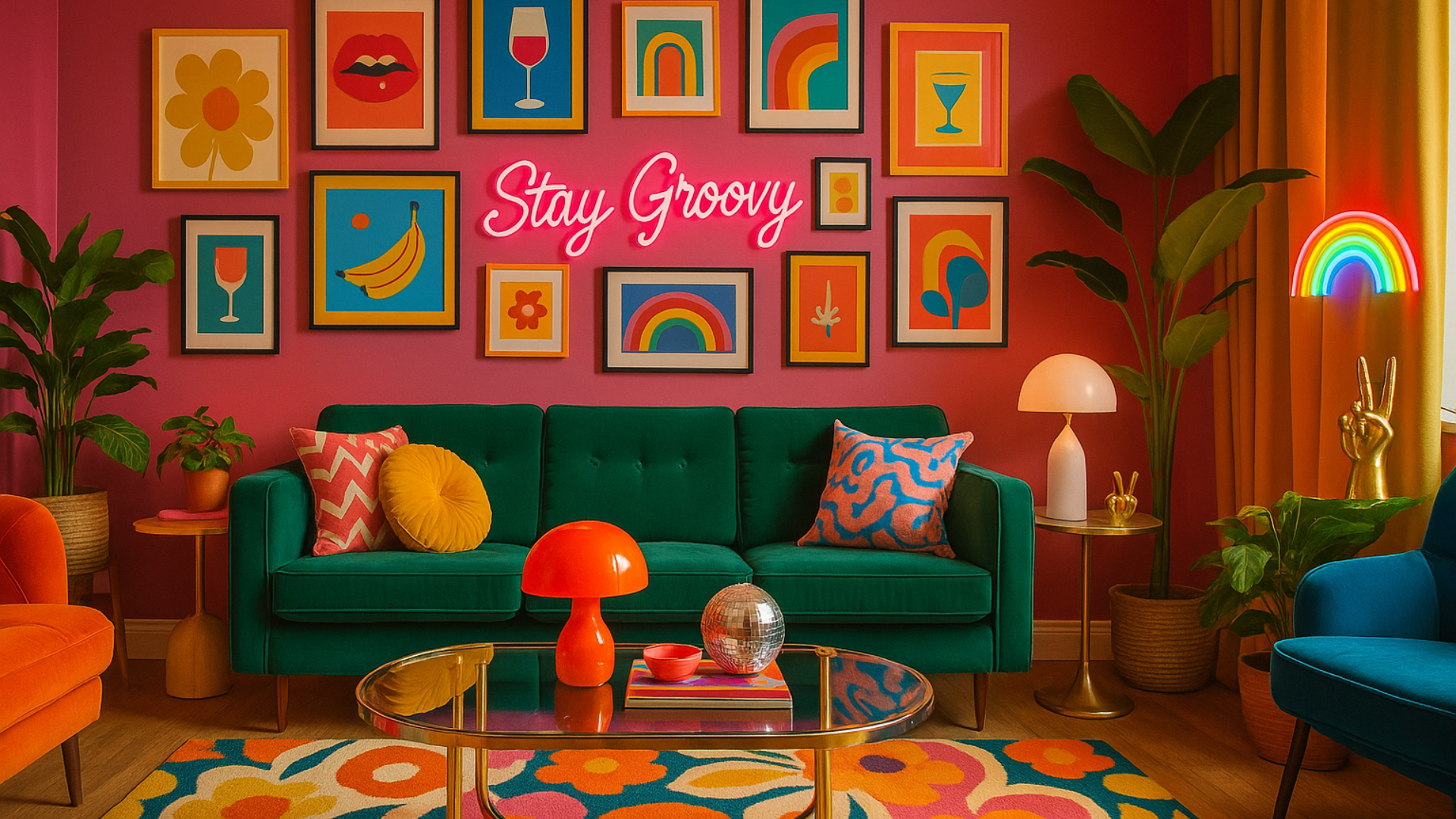
One wall can be wallpapered with retro geometrics or a saturated colour. Next to it, serene walls are restful. - Anchor sofa
We prefer a mid-tone sofa (bottle green, petrol blue) and multicoloured cushions with two-tone repetition. - Art and objects
We combined pop prints, "classic" gilt frames and a humorous piece (a mirror in the shape of a cloud, for example). The key: grouping by visual families.
Kitsch style in bedroom decoration
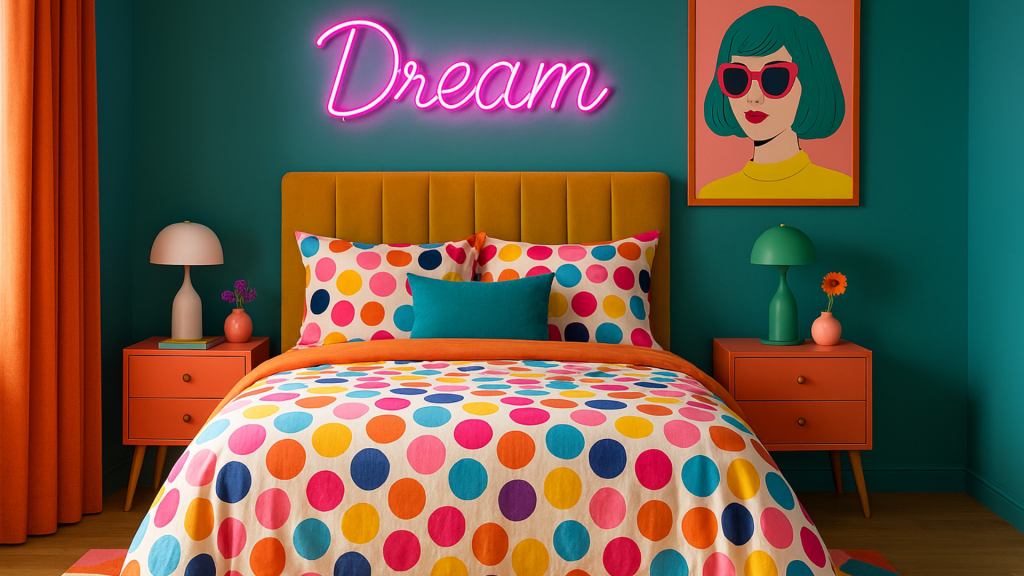
- Headboard protagonist
Upholstered with velvet or high gloss lacquer capitonné. - Bedside tables and lamps
Likely mix: vintage bedside tables with globe lamps. - Textile
Plain bedspread + patterned cushions repeating two of the colours of the headboard.
Kitsch style in kitchen decoration
- Kitchen front
Fish scale" or metre tile in saturated colour; brass handles. - Dining room
mismatched chairs, though twinned by colour; a small neon lamp declaring a winking phrase.
Kitsch style in bathroom decoration
- Two-colour tile with "improbable" border.
- Mirror with gilt or pastel frame.
- Chrome towel rails and a kitsch piece (an eccentric vase) as a finishing touch.
Examples of combinations in kitsch style
- Bottle green sofa + strawberry pink and cream cushions + marble coffee table + chrome globe lamp + pop print with typography.
- Mustard lacquered sideboard + gold mirror with organic shape + blown glass vases in gradient + discreet animal print rug.
- Bedroom with lilac velvet headboard + vintage wooden bedside tables + metal mushroom lamps + paintings in a series of pastel colours.
In all cases, we are back to the rule: one "jewel" piece, two repeated colours and textures that contain the shine.
Preguntas frecuentes sobre decoración de interiores estilo kitsch
¿Qué es exactamente el estilo kitsch en decoración de interiores?
El estilo kitsch es una forma de decorar que mezcla piezas llamativas, referencias retro, objetos con valor emocional, colores intensos y contrastes estéticos muy marcados. Aunque pueda parecer improvisado, funciona mejor cuando hay una intención clara detrás y una composición bien pensada.
¿Cómo decorar con estilo kitsch sin que la casa se vea recargada?
La clave está en trabajar con jerarquía visual, repetir algunos colores o materiales y dejar zonas de descanso visual. El estilo kitsch no consiste en llenar todo de estímulos, sino en combinar elementos con personalidad de forma controlada para que el conjunto tenga sentido.
¿Qué colores se usan más en una decoración estilo kitsch?
Suelen utilizarse bases neutras cálidas, como hueso, crema o gris topo, combinadas con colores protagonistas más intensos como fucsia, turquesa, limón, verde ácido o naranja pop. Lo importante es no introducir demasiados acentos a la vez y repetir algunos para crear coherencia
¿Qué muebles y materiales encajan mejor en el estilo kitsch?
Encajan muy bien muebles vintage o de inspiración retro, piezas lacadas, metales pulidos, espejos con formas llamativas, metacrilato, textiles con textura y maderas con veta visible. La mezcla entre materiales brillantes y acabados más cálidos suele aportar el equilibrio que este estilo necesita.
¿Se puede aplicar el estilo kitsch en un salón sin que resulte infantil?
Sí, perfectamente. Para conseguirlo, conviene elegir una pieza principal que ancle el espacio, como un sofá o una pared protagonista, y después sumar objetos decorativos con carácter sin perder el equilibrio. La calidad de los materiales y la forma de agrupar los elementos marcan mucho la diferencia.
¿El estilo kitsch también funciona en dormitorios y cocinas?
Sí, puede funcionar muy bien en distintas estancias. En dormitorios suele aplicarse a través del cabecero, las lámparas o los textiles, mientras que en cocinas puede entrar mediante azulejos de color, tiradores con personalidad, sillas desparejadas o iluminación decorativa con un punto irónico.
¿Cuál es el error más común al decorar una casa con estilo kitsch?
Uno de los errores más habituales es confundir este estilo con el exceso sin criterio. Cuando no hay repetición de colores, contraste medido ni una selección cuidada de piezas, el resultado puede verse caótico. En el kitsch, el humor y la mezcla funcionan mejor cuando van acompañados de orden y cierta calidad en los acabados.
What they say about us
Publicado en Google
 Bert Jan Vukkink
Trustindex verifica que la fuente original de la reseña sea Google.
We gave our interior design project to the ladies of Tarraula with great pleasure. Their ideas and design ideas went much further than what you see in their store. Our final interior design was perfect and very different in style on what you see at their place. There are no limitations. Anything, from anywhere in the world can be ordered through them. We would thank the Tarraula team for their dedication, advices, quality and great after sales support! It was really a great pleasure working with Tarraula. We can highly recommend them!Publicado en Google Marc HoneggerAn absolute pleasure to work with – highly recommended! ⭐⭐⭐⭐⭐ A bit more than a year ago, we bought a house in Spain dating back to 1998 and decided to completely renovate it. We were looking for an interior designer who could understand our ideas, develop a concept for the renovation and interior, and also coordinate the entire project, including the selection and purchase of furniture. After two disappointing experiences with other interior designers, a colleague recommended Cristina from Tarraula in Jávea. And what a lucky recommendation that turned out to be! From our very first meeting, we immediately felt that Cristina understood us and what we were looking for. She listened carefully to our ideas, made fantastic suggestions and had a wonderful sense of how to create the atmosphere and style we had in mind. We loved her ideas for both the renovation and the furniture, and very quickly felt confident enough to entrust her with the entire project. Four months later, we returned to Spain and were absolutely blown away. Wow – what a transformation! Our house had been completely renovated and turned into a beautiful, warm and stylish Spanish home. The furniture was carefully selected, the workmanship was excellent, and every detail came together perfectly. Cristina and her colleague did a fantastic job coordinating and supervising the entire renovation. The craftsmen were excellent, everything was handled professionally, and the quality of the work was truly outstanding. But what matters most to us is how we feel about the result: we absolutely love our home! It now has exactly the style and atmosphere we had hoped for – and honestly, we cannot imagine having done it any better. Looking back, we can say with complete confidence that the investment was absolutely worth it. We are incredibly happy that we found Cristina and would wholeheartedly recommend her and the entire Tarraula team to anyone looking for creativity, professionalism, quality and someone who genuinely cares about creating a home that reflects the people who live in it. Thank you so much, Cristina, for turning our house into the home we dreamed of! ❤️Publicado en Google
 Olha BarkhausenTarraula is highly recommended design company. They decorated our entire villa, from the wallpaper, which gave each room a unique look, to the curtains, pillows, and bedding. Tarraula collaborates with many factories and suppliers, so you can choose any style, any color for your home, any piece of furniture or decor. Combined with excellent service and a professional team. The company also provides follow-up services if needed. We've been working with Tarraula for five years, and it's been a successful collaboration.Publicado en Google
 merel de ruiterDear Christina, After two years of renovations, we can finally fully enjoy our home in Jávea! And it has turned out absolutely beautiful! Thanks to all your hard work, ideas, and dedication, it has become exactly what we had envisioned. Thank you so much for all your help and for such a lovely and enjoyable collaboration! You have truly helped make this house feel like our second home. With love, Marieke & HenkPublicado en Google
 Patrick MolinariCristina, Elisa, and Guillermo embody professionalism. Our family worked with them to furnish our home and we could not be more satisfied. Cristina and her team are experts and highly competent at working with you remotely. From plan development, selection of furniture, textures, and so forth they really came through for us. The installation is flawless and their service level is unmatched. We will certainly be working with them again. We have no hesitation in recommending them and we stress that you are in fantastic and very professional care with Tarraula.Publicado en Google
 josBehulpzaam en vriendelijk personeel. Prachtige hoekbank gekocht. Opslaan geen probleem ivm oplevering apt in september.Publicado en Google
 Teodor NikolovUn sitio magnífico, gente maravillosa, energía positiva 🏆💪🏼💎Publicado en Google
 Eric De CosterMet Tarraula hebben we geheel onze nieuwe tweede woonst ingericht. Cristina heeft een zeer goede hedendaagse smaak die de onze perfect matcht, zij heeft leuke ideeën en is comminucatief. De afspraken waren steeds correct alsook de prijs en we verheugen ons met het prachtige resultaat van onze binnenhuisinrichting. Een aanrader!Publicado en Google
 deborah CoenWe have worked with a Cristina and the Tarraula team for the last 5 years as we needed to furnish a second home remotely through Covid restrictions. Cristina listened to what we liked and didn't like and offered an iteresing range of furniture and accessories using zoom and powerpoint presentantions. Cristina is brillant at judging scale and proportions and finds clever solutions to decorating difficult spaces. She continues to be iterestede in how we are finishing the house and we are realy grateful for all her ideas. Hes instalation team are also first rate and totally trustworthy.